Launching a coffee brand in Canada has never been more accessible. But choosing the right private label coffee supplier to partner with is one of the most important decisions you will make, and one of the easiest to get wrong.
The problem is that private label coffee suppliers are not all built for the same kind of customer. Some are large-scale operations designed for national grocery brands. Some are built for distributors moving high volume. Some want you to supply your own packaging. Some are really roasting spaces designed to teach you to roast yourself. And a few are true turnkey partners built to hand you a finished, ready-to-sell product.
If you pick a supplier built for a different type of customer than you, you end up with big minimums you cannot meet, surprise costs, packaging headaches, or a product that does not match your vision.
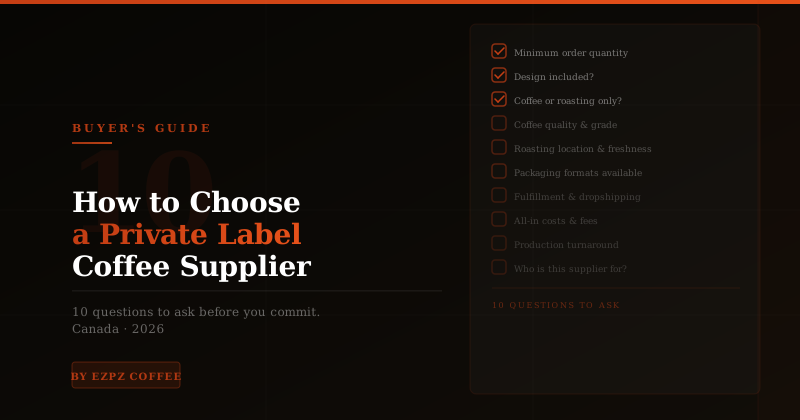
This guide walks you through the 10 questions you should ask any private label coffee supplier in Canada before you commit. Ask these, and you will quickly separate the right partner from the wrong one.
1. What is your minimum order quantity?
This is the first question, because it filters out most suppliers immediately.
Many Canadian private label programs are built for distributors and large brands, which means minimums of 500, 1,000, or even several thousand units per product. That is a serious upfront commitment before you have sold a single bag or validated that anyone wants your coffee.
If you are a restaurant, boutique, gym, hotel, or new brand testing an idea, a high minimum is a dealbreaker. Look for a supplier with a low or zero minimum order so you can start small, prove the concept, and scale when the demand is real. Starting with a manageable test batch is far smarter than gambling on thousands of units.
2. Is the custom design included, or do I have to supply my own packaging?
This one surprises a lot of first-time brand builders. Many private label suppliers expect you to arrive with print-ready design files or your own supplied bags and labels. They roast and fill, but the packaging and design are your problem.
That means hiring a designer, sourcing compliant packaging, and managing print production separately — all before you can launch. It adds cost, time, and complexity.
Ask directly: is full custom design included, or do I supply my own? A supplier that includes design takes an enormous burden off your plate and gets you to market faster.
3. Does the service include the coffee, or just the roasting and packaging?
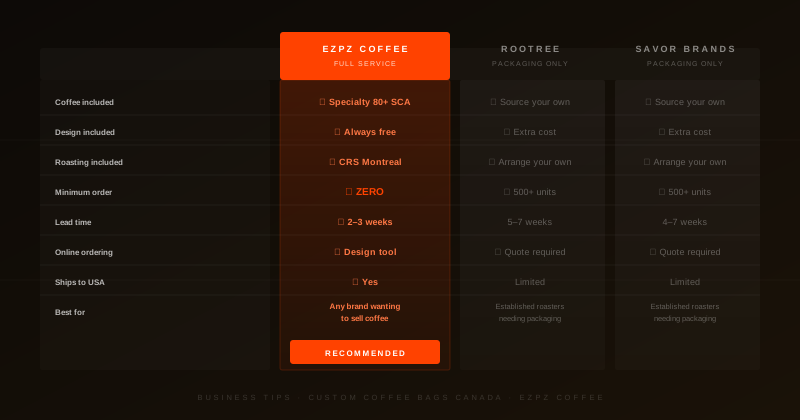
It sounds obvious, but clarify exactly what you are buying. Some packaging companies sell you empty bags and leave the coffee entirely to you. Some roasting spaces roast coffee you have to source yourself.
A true turnkey private label partnerprovides the specialty coffee, the roasting, and the packaging as one finished product. You should know precisely where the supplier's responsibility ends and yours begins, before you sign anything.
4. What is the quality of the coffee, really?
Not all coffee is created equal. Ask whether the coffee is specialty grade, whether it is traceable to specific farms or regions, and what its score is on the SCA cupping scale. Specialty grade generally means a score of 80 or above.
A beautiful bag filled with mediocre commodity coffee is a one-time sale. A beautiful bag filled with genuinely excellent coffee builds a brand customers return to. Always ask for samples and taste before you commit. If a supplier will not send samples, that tells you something.
5. Where is the coffee roasted, and how fresh is it?
Freshness matters enormously in coffee. Ask where the roasting happens and how quickly the coffee is packaged and shipped after roasting.
Coffee roasted in Canada and shipped domestically arrives fresher and faster than coffee roasted abroad and shipped across borders, where duties and delays also come into play. If freshness and a local story matter to your brand, roasting location is a real factor.
6. What packaging formats and options are available?
Your brand may need more than one format. Ask about available bag sizes, materials, and colours, whether resealable zippers and one-way degassing valves are standard, and whether whole bean and ground are both offered.
If you have bigger ambitions, ask whether they also offer formats like ready-to-drink coffee, capsules, or freeze-dried instant coffee. A supplier with a broad product range lets you expand your brand without switching partners later.
7. Do you offer fulfillment and dropshipping?
If you plan to sell online, this is critical. Ask whether the supplier can ship directly to your customers under your brand, and whether they integrate with your ecommerce platform such as Shopify.
Dropshipping and direct fulfillment mean you never touch inventory, never manage a warehouse, and never handle shipping yourself. For a DTC coffee brand, this can be the difference between a manageable side project and a logistical nightmare.
8. What are ALL the costs?
Get the full picture, not just the per-unit price. Ask specifically about setup fees, monthly fees, design fees, storage fees, and shipping costs.
Some suppliers advertise an attractive per-bag price but layer on charges that change the real economics entirely. A transparent partner will lay out every cost clearly so you can calculate your true margin. If you cannot get a straight answer on fees, be cautious.
9. How fast is production and turnaround?
Timing can make or break a launch, a seasonal product, or an event. Ask about typical production and fulfillment times, both for your first order and for repeat orders.
Some suppliers built for large volume have long lead times of many weeks. Others can turn around a small branded batch in about a week. Match the turnaround to your needs, especially if you are working toward a specific launch date or holiday.
10. Who is this supplier actually built for?
This is the question that ties it all together. Be honest about who you are — a small brand, a restaurant, a distributor, a national grocery player, an entrepreneur testing an idea — and ask who the supplier primarily serves.
A supplier built for national distributors will not prioritize your 100-bag test run. A supplier built for small and growing brands will. There is no single best private label coffee supplier in Canada — there is only the best fit for your specific situation. The right partner is one whose ideal customer looks like you.
The Bottom Line
Choosing a private label coffee supplier in Canada comes down to matching their model to your needs. Big distributors and grocery-focused roasters are excellent for high-volume national brands. Roasting collectives are great if you want to learn to roast yourself. Packaging companies work if you already have your coffee sourced.
But if you are a restaurant, hotel, boutique, gym, DTC brand, or entrepreneur who simply wants to sell great coffee under your own name — with a low barrier to entry, design included, and the whole product handled for you — look for a true turnkey partner built for brands of your size.
That is exactly why we built EZPZ Coffee. Zero minimum order, full custom design always included, specialty grade coffee roasted fresh in Montreal, and everything from packaging to dropshipping fulfillment handled as one finished product. From a single test bag to national volumes, built to grow with you.
Whatever you choose, ask these 10 questions first. The right answers will lead you to the right partner.